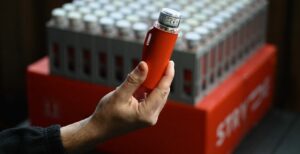
STRYDE node ©STRYDE
STRYDE is a global land seismic solutions company that serves international subsurface imaging markets and collaborates with leading academic institutions on research projects.
Its seismic data acquisition technology leverages ultra-lightweight, compact nodal sensors. These sensors enable the assessment of a wide range of applications, including geothermal exploration and monitoring, archaeological exploration, oil and gas exploration, and many others.
An example of STRYDE’s collaboration with academic research in France is the use of its seismic sensors in a study led by Sébastien Chevrot[1], focusing on geophysical challenges related to seismicity in the Pyrenees.
We recently spoke with Amine Ourabah, STRYDE’s Chief Geophysicist. In the following Q&A, he shares how STRYDE collaborates on academic research and how this contributes to their product development.
[ISIFoR] Does STRYDE frequently collaborate on academic research projects? If so, could you give us a few examples?
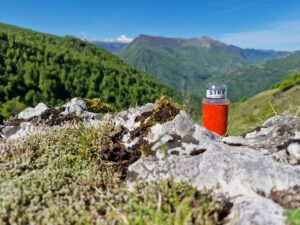
©Amine Ourabah
[Amine Ourabah] Yes, we have supplied seismic equipment to over 20 universities worldwide, including the University of Oxford, KAUST, Caltech, Virginia Tech, and ETH Zurich. These institutions have used our technology to acquire high-quality seismic data across a wide range of research applications, such as animal monitoring, geothermal exploration, seismicity monitoring, mineral exploration, geohazard assessment, and agricultural research.
[ISIFoR] What is appealing to your company about a collaboration such as the one with Sébastien Chevrot and Matthieu Sylvander[2]?
[Amine Ourabah] Being part of this pioneering effort and contributing to the discovery and development of a new clean energy source like natural hydrogen is a unique, motivating, and highly rewarding experience for STRYDE.
It’s also been particularly valuable to see our nodes used in innovative ways – such as Chevrot’s team (Géosciences Environnement Toulouse laboratory) applying them in a dense setup traditionally reserved for active seismic acquisitions. This not only highlights the benefits of higher trace density in passive recording but also reinforces that our technology extends well beyond conventional active seismic reflection.
These kinds of applications help demonstrate that our solutions can support a much broader range of industries in de-risking subsurface activities. At the same time, the feedback we gain from such collaborations directly informs our product development, pushing us toward more adaptable systems and peripherals.
Ultimately, projects like this give new audiences the opportunity to access and use cutting-edge technology, opening the door to entirely new possibilities in their research and operations.
[ISIFoR] Do you believe that the dialogue between STRYDE’s R&D department and the academic research community should be ongoing in the interest of continuous improvement?
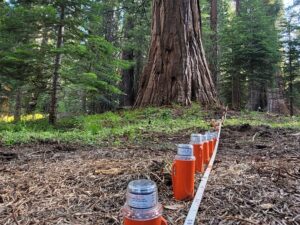
©Virginia Tech
[Amine Ourabah] Yes absolutely. Ongoing dialogue between STRYDE’s R&D team and the academic research community is essential for continuous improvement of the STRYDE system. Academic users often push technology into new and unconventional applications, generating valuable feedback that helps refine performance, usability, and data quality.
This collaboration creates a virtuous cycle: researchers gain access to cutting-edge, affordable technology that enables new discoveries, while STRYDE benefits from real-world insights that drive innovation and product development. Maintaining this close relationship ensures the system continues to evolve in line with emerging research needs and industry challenges.
[1] Research Director at GET.
[2] Assistant Physicist, CNAP IRAP, Midi-Pyrénées Observatory