
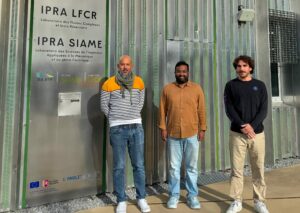
David Grégoire, Deepanshu Shirole and Marc Luthy
In December 2025, on the UPPA campus in Anglet, we met Deepanshu Shirole, professor at IIT Delhi. Invited by David Grégoire, professor at UPPA, they discussed research projects and Professor Shirole presented his work at a conference.
What do these researchers have in common? Finding innovative solutions for sustainable construction that emits less CO2 and can adapt to unstable soils if necessary. To do this, they are exploring, between Delhi and Anglet, the possibilities offered by the technique of electrodeposition.
Here is a brief overview of what this work involves and the origins of this collaboration, which began at Northwestern University a few years ago.
When matter changes state: a technique, electrodeposition, and complementarity between researchers
It starts with a question of infrastructure survival. Deepanshu Shirole devotes his research to “poor soils”. This mysterious term refers to a critical technical reality: soils that are unable to support the weight of a building or withstand the forces of nature (earthquakes, landslides, coastal erosion). In India, from the Himalayas to the southern coast, this challenge is immense and well known, resulting from the spread of human construction imposing buildings in areas that were unbuildable.
To address this issue, Professor Shirole uses an innovative geotechnical technique: electrodeposition.
“It’s a bit like electroplating1, which we learn about in high school, but applied to soil. We use an electric field to precipitate minerals into the pores of the soil, creating natural cohesion in a matter of days, where geology would take centuries,” he explains.
This is where David Grégoire’s work joins that of Professor Shirole. Expert in the physics of porous media, David has long studied the negative effects of crystallization (in the context of coastal erosion due to salt, or in geological gas storage). By combining their approaches, a synergy emerges:
- David’s micro approach: understanding precisely how crystals form and interact at the scale of rock pores,
- Deepanshu’s macro approach: testing the overall strength of the soil and its behavior in the field.
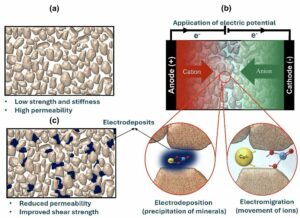
Process of electrodeposition and it’s impact
The project: building and fixing
The duo’s ambition is to transform these advances into concrete solutions for low-carbon construction. The key idea? Use shell waste as a granular skeleton and electroplating as a natural “glue.”
The aim is to show that cohesion can be created without using a single gram of cement. If the project is successful, it could lead to the creation of insulating bricks or the direct stabilization of soils for construction with a very low carbon footprint. There are also plans to combat coastal erosion directly by strengthening the cohesion of geo-materials specific to the Indian and French coasts. During their stay in Anglet, initial laboratory tests, , carried out with Marc Luthy, confirmed the potential of this work and reinforced the two researchers’ desire to continue their joint efforts.
The origins of the current project: a meeting at Northwestern University
This collaboration did not come out of nowhere. It began several years ago at Northwestern University (USA), within the New Pores Hub (supported by E2S UPPA). At the time, Deepanshu was a researcher there and David was a visiting professor.
Their current exchange demonstrates the clear importance of scientific mobility and joint projects that bring different fields of research together. What was then just a theoretical discussion has now become a formal collaboration between IIT Delhi and UPPA. Deepanshu Shirole’s visit to France was made possible thanks to a mobility grant funded by Campus France (SSHN) with the support of Carnot ISIFoR, which supports and encourages such exchanges.
From Delhi to Anglet: a committed journey
Deepanshu Shirole’s career path is that of a researcher focused on society. Initially tempted by public service in India, it was his encounter with a passionate professor that pushed him towards research to address the geological risks facing his country.
After spending time in the United States, he returned to India to continue working in this field. Today, together with David Grégoire, he is forging a lasting link between Anglet and New Delhi.
What’s next? A joint proposal for a large-scale Franco-Indian research project and, without a doubt, more trips back and forth between the two countries to build, literally, a more sustainable future.
- Process of using electroplating to coat an object with a thin layer of metal.