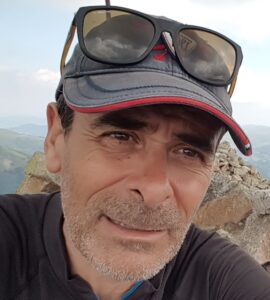
Patrice Baby
Pyrsmin, led by Patrice Baby (IRD research director at GET), aims to reexamine historic metal deposits in the Pyrenees to better understand their origin and potential. It focuses on the Ariège region to develop a new classification system for these deposits, assess their content of strategic metals, and develop new techniques to extract these metals from the tailings of past mining operations.
This project benefits from a new type of funding from Carnot ISIFoR and brings together three accredited laboratories from our institute: GET, LFCR, and IPREM. It leverages synergy across laboratories and disciplines to address this topic—from the sedimentary basin down to the atomic level.
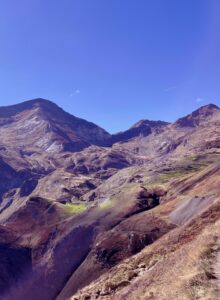
Bentaillou Mine (Ariège Pyrenees) (Photo by M. Guignes)
Where did this project come from?
The Pyrsmin project originated from the desire to adapt an innovative concept—one that had been successfully tested on the other side of the world—to a region geographically closer to the GET: the Ariège Pyrenees. The idea stems from a previous project funded by ISIFoR, called Orpet, which was led by Gleb Pokrovski in Peru.
“It worked in Peru. It’s a fairly new concept. We demonstrated that there is a significant relationship between gold and organic matter in the basins, and we believe these relationships can apply to many metals and many types of deposits,” explains Patrice Baby.
It was through discussions with Jean-Paul Callot and the teams in Pau—who were already studying similar issues, particularly regarding uranium—that the project took shape. Recognizing how their areas of expertise complemented one another, the idea of launching a major interdisciplinary study began to take shape.
What are the objectives of the Pyrsmin project?
Pyrsmin stands out for its comprehensive approach, applying the concept of a “mineral system”—a method long used in oil exploration—which involves studying geological features at the sedimentary basin scale to understand the movement and accumulation of fluids.
The scientific goal is clear: to revisit Pyrenean geological models that have seen little updating since the 1970s. The study area selected is Ariège, a region rich in former lead and zinc mines that ceased operations in the 1950s.
Beyond pure geology, the project addresses a strategic European issue: sovereignty over critical raw materials. The former mines in Ariège contain, among other things, germanium, a critical metal identified by Europe as key to reducing dependence on China in the coming decades. Among its objectives, Pyrsmin will seek to assess whether the old mining waste at these sites can be viably reprocessed.
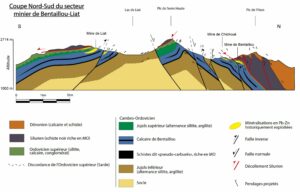
Cross-section taken from Mr. Guignes’s master’s thesis (Guignes, 2026).
The work carried out by Pyrsmin will also reevaluate the presence and potential deposits of metals in light of the geopolitical reality and new needs driven by the energy transition.
“There will be changes in geological models. […] Geological data is being revised, and we’re realizing there are quite a few gaps […]; our ‘geological vision’ is going to be different.”
From the Basin to the Atom: How Is the Project Being Implemented?
The implementation of Pyrsmin relies on close collaboration among three laboratories (GET, IPREM, and LFCR), enabling research that spans a scale ranging “from the sedimentary basin to the atom.” The program is structured into several complementary components:
- A structural and regional geology component: to understand the geometric architecture, the history of basin deformation, the location of organic matter, and fluid migration pathways.
- A fluid-rock experimental component: conducted in the laboratory to analyze complex physical and chemical interactions.
- A technology and extraction component: based in Pau, this component relies in particular on the LFCR’s equipment, which will enable the visualization of sample behavior and the analysis of options for reprocessing mining waste.
This is a large-scale project in terms of both its methodology and its objectives. Although the Ariège region may seem limited in scope, there is much work to be done, with the ultimate goal being to “develop a methodology and a vision that can be applied to other regions in France or around the world.”
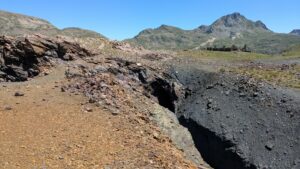
Liat Mine (Val d’Aran) (Photo by P. Baby)
All quotes in quotation marks are from Mr.Baby